FTC 4410's 2026 World Championship Robot
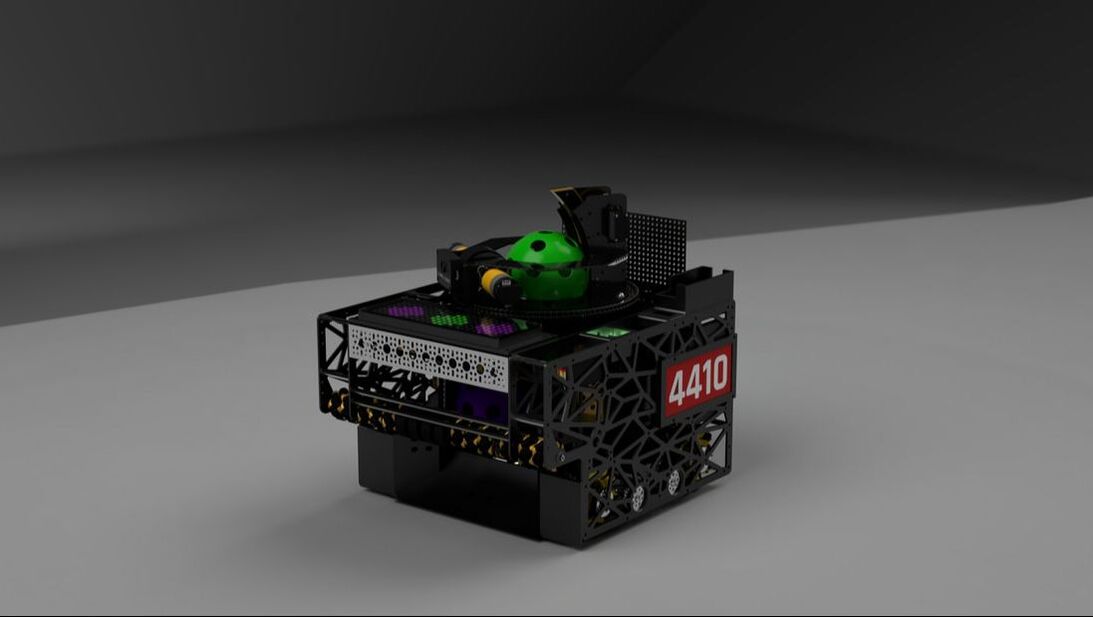
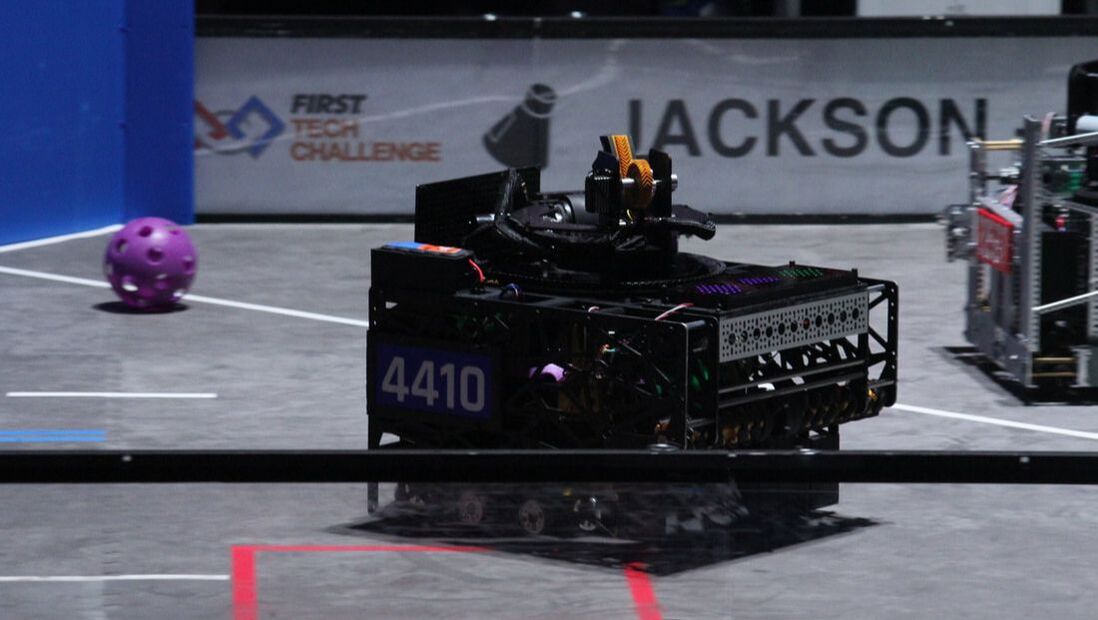
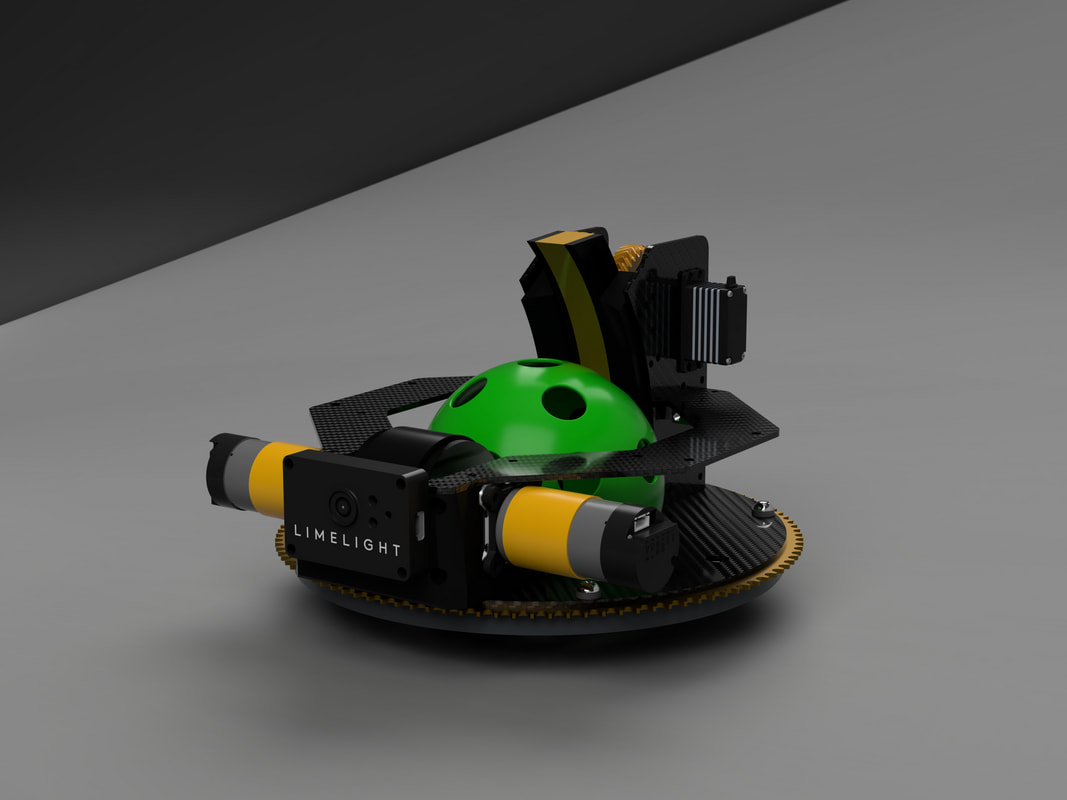
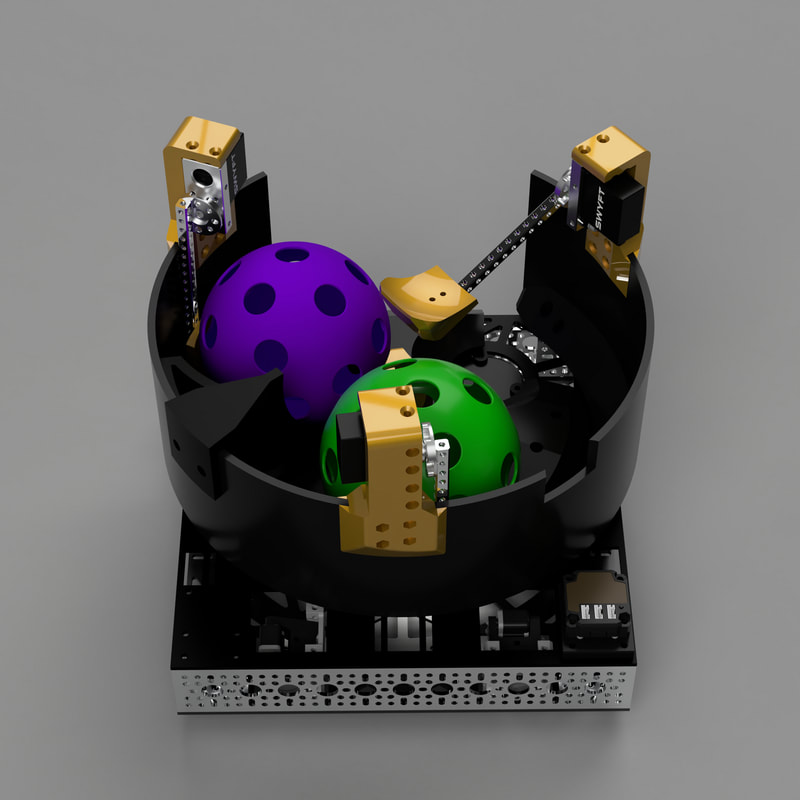
FTC 4410's 2026 World Championship Robot
September 2025 - April 2026 (12th Grade)
- Robot developed for the 2025-2026 FIRST Tech Challenge Season, “DECODE”
- Competition Results:
- Represented Massachusetts at the FIRST World Championship for the second consecutive year.
- Earned 2nd Place Inspire Award at the 2026 FIRST Championship, one of the highest overall honors in FIRST Tech Challenge out of 8000+ teams internationally.
- Competed with a robot designed for rapid full-field shooting, automatic color sorting, defensive durability, and highly automated operation.
- Three Primary Objectives:
- Rapidly collect “Artifacts” from the field and store up to three inside the robot.
- Identify each Artifact’s color, arrange shots into the required “MOTIF” sequence, and launch Artifacts into the goal from anywhere on the field.
- Score additional endgame points by lifting the robot high enough for an alliance partner to park beneath it—or continue cycling Artifacts when that strategy produces more points.
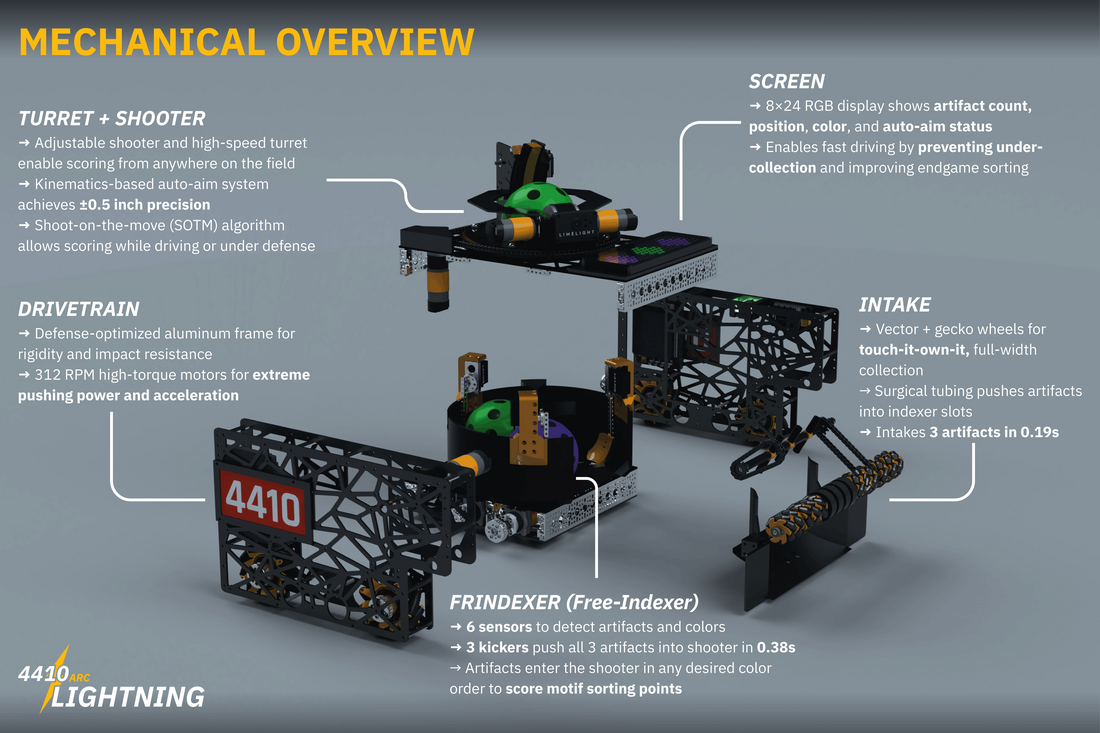
- Rigid Aluminum Drivetrain: Replaced the original plywood frame with a custom chassis constructed from pocketed 1/8" 6061 aluminum, adding 15 lb for greater rigidity, collision resistance, and the ability to withstand aggressive defense.
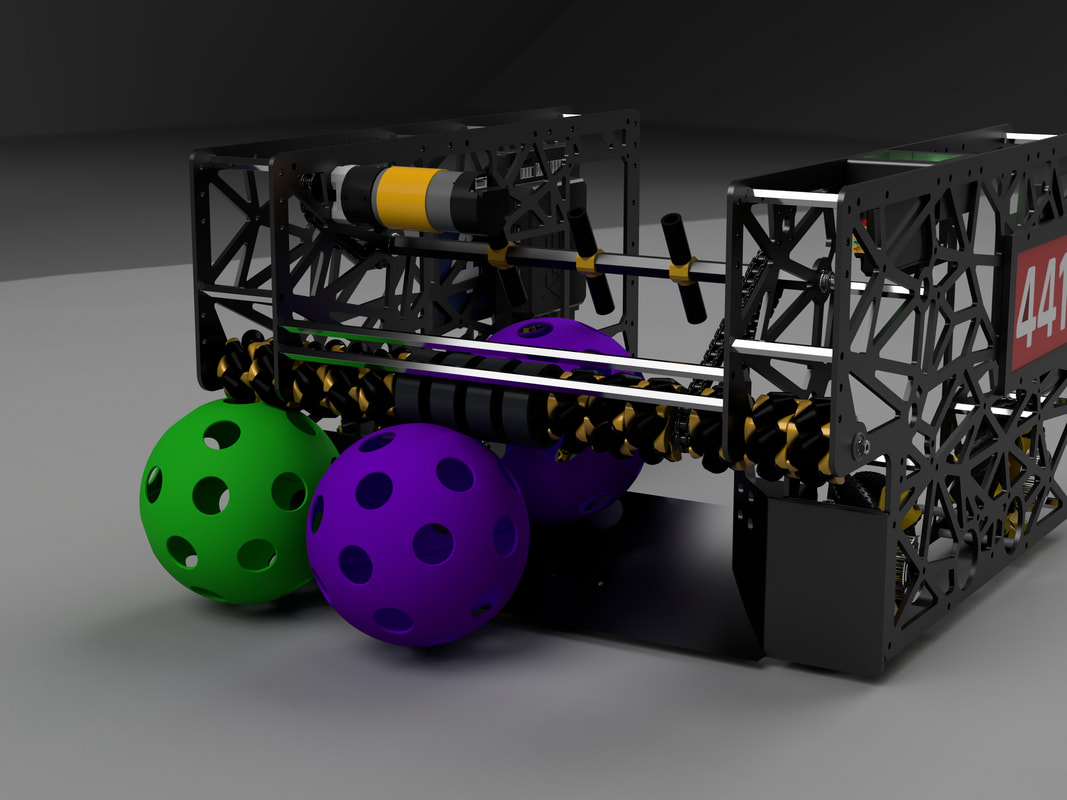
- Dual-Row Wheel & Surgical-Tubing Intake: Collects three Artifacts in 0.19 seconds. Tubing durometer, length, ramp geometry, and motor power were experimentally optimized for rapid and reliable collection.
- Frindexer Color-Sorting System: Custom three-slot storage mechanism using six color-and-distance sensors and three independently controlled servo kickers to identify, store, select, and shoot Artifacts in the correct MOTIF sequence.
- Increased kicking consistency from 14.2% to 99.7% through more than 100 component iterations.
- Integrated intake rollers reduced the force required to funnel an Artifact from 28 N to 2.3 N, a 92% decrease.
- Allows the robot to intake Artifacts in any order and automatically determine the correct shooting sequence.
- 360° Turret: Rotates through a full revolution in 0.45 seconds, allowing the shooter to remain aimed at the goal independently of the drivetrain’s orientation.
- Dual-Flywheel Shooter: Two flywheels spinning at up to 6,000 RPM, combined with an adjustable hood, provide a range exceeding 15 ft, 99.2% shot consistency, and approximately ±0.5" precision.
- Added flywheel weights increased rotational inertia to 283.85 kg·mm², reducing recovery time between consecutive shots by 62%.
- Enables rapid-fire scoring without requiring the robot to stop moving or face the goal.
- Endgame Lift Development: Developed a two-stage linear-slide lift producing 270 N of force and raising the robot 19 inches in under seven seconds.
- Used 3:4 gearing, smaller cable spools, reversible ratchets, carbon-fiber supports, and mechanically linked axles.
- Reduced lift current draw by 56% while improving stability and allowing the robot to maintain its height without continuous motor power.
- Removed the lift before the World Championship after strategic analysis showed that continued Artifact cycling would score more points.
- Removing the lift reduced cycle time by 16% and enabled five additional cycles worth 45 points.
- Advanced Control Stack:
- Four-Stage Auto-Aim System combining dead-wheel odometry, IMU heading, and AprilTag camera localization with turret control, shooter-speed calculation, predictive feedforward, and ballistic compensation.
- Turret PID Control continuously tracks the goal while the drivetrain moves and rotates.
- Distance-Based Shooter Interpolation calculates the required flywheel velocity and hood position based on the robot’s location.
- Predictive Feedforward compensates for drivetrain movement so the robot can accurately shoot while driving.
- Ballistic Velocity Compensation adjusts the launch solution based on the robot’s translational velocity.
- Configurable Autonomous Architecture capable of generating approximately 3.9 million possible routines from reusable path and action segments.
- 18-Artifact Color-Sorted Autonomous capable of scoring 75 points and a 24-Artifact Autonomous capable of scoring 93 points.
- Distributed Sensor Processing reduced the main control-loop time from approximately 210 ms to 22 ms, stabilizing drivetrain localization, turret control, and automated actions.
- Sensor and Driver-Assistance Systems: Integrates 20 sensors across six sensor types, including color-and-distance sensors, encoders, an IMU, cameras, and limit detection.
- RGB displays communicate Artifact colors and storage status to the drive team.
- Controller vibration alerts drivers when Artifacts are collected or the robot requires attention.
- Automatic over-intake prevention stops the intake once all three Frindexer slots are occupied.
- One-button shooting automatically selects and launches Artifacts in the correct color sequence, substantially reducing driver workload.