June 2025 – August 2025 (11th Grade)
- 32 Custom Structural Parts fabricated via 3D printing (PLA/TPU) and laser-cut polycarbonate.
- Designed around three primary goals:
- Geometric Consistency: Toe play within ±0.82 mm (65% reduction from legacy Neo), drivetrain velocity stability within ±1%.
- Classroom-Grade Durability: Reinforced drivetrain crossbars, stiffer suspension, FEA-validated crumple bumper, and high-torque steering linkage.
- Supply-Chain Independence: Fully custom, open-source architecture with parts manufacturable on desktop FFF printers and low-cost laser cutters.
- Geometric Consistency: Toe play within ±0.82 mm (65% reduction from legacy Neo), drivetrain velocity stability within ±1%.
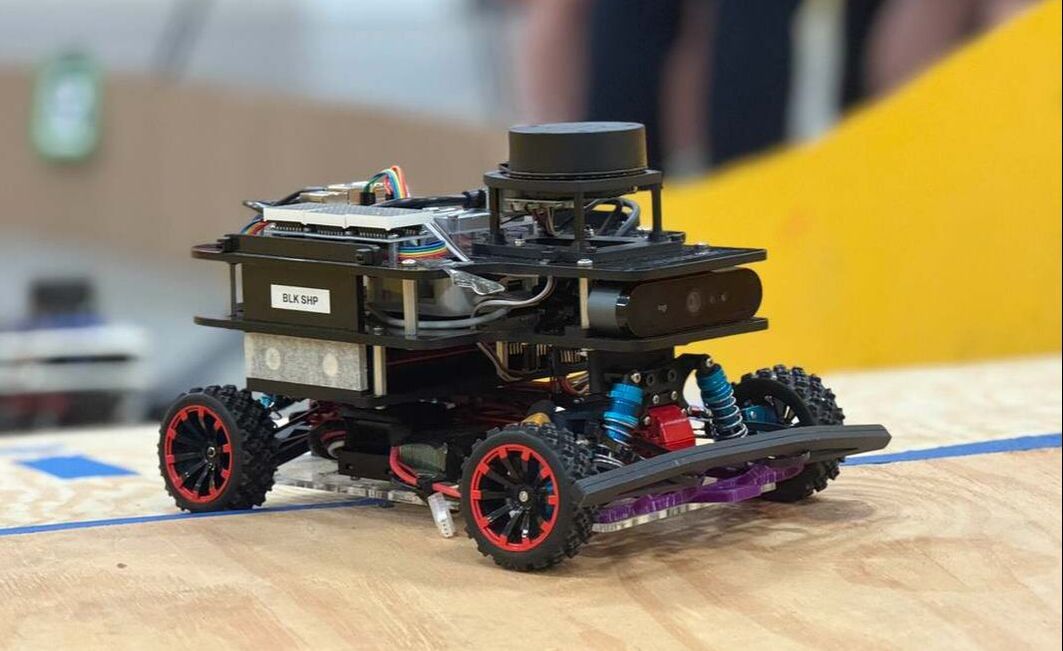
- Fully custom successor to the MIT RACECAR Neo, designed for reproducibility, durability, and supply-chain independence.
- Dual bell-crank Ackermann steering linkage with multi-axis two-bar mechanism; ±0.82 mm toe play (65% reduction from legacy Neo).
- Brushless drivetrain (REV Neo 550 + SPARK MAX) with double-differential system; sustained velocity stability within ±1%.
- Tested up to 11.88 m/s with acceleration exceeding 20 m/s².
- Shock-absorbing bumper with FEA-validated crumple zones; 280 N impact modeled at 7 m/s, deformation limited to 2.33 mm.
- Suspension upgraded with 70% stiffer springs, yielding 14.5 mm ground clearance for outdoor operation.
- Software integration included recursive motion profiler and acceleration limiter to eliminate torque-spike damage.
- Designed around unmodified RACECAR Neo payload (Raspberry Pi 4, LiDAR, IMU, Camera) for curriculum compatibility.
- Enabled classroom reproducibility and algorithm transferability across vehicles, reducing hardware variability and failures.
- Authored accompanying research paper: Design and Evaluation of a Scalable Educational Testbed for Autonomous Vehicle Instruction